
Searching for a Warrant in St. Louis County
Every St. Louis County channel here costs nothing, yet no single one tells the whole story. Go down the list in order and stop when an office gives you a firm answer in person.
- Open the two outstanding warrant PDFs from the Sheriff's Warrant Division and read the timestamp in the header first.
- Search each document for the full name. A list line shows age, city, state, issued date, bail amount, type, and charge.
- Query Minnesota Court Records Online by name, case number, citation number, or attorney when you want case context.
- Call Court Administration in Duluth, Hibbing, or Virginia and ask whether the order is still open.
- Request a specific document from Sheriff Central Records if you need paper rather than a status.
Note: These St. Louis County lists are generated files, so a miss proves nothing until the court itself answers the question.
No Name Box on St. Louis County Warrant Lists
The St. Louis County list is a PDF, not a database. There is no name field, no court or offense filter, no date filter, no account, and no export option. Your browser's find tool is the only search the document allows, and it matches text exactly as printed. An entry spelled differently, or one not yet added, simply will not appear. That is the limit of the format.
Watch the timestamp: both lists regenerate nightly around 9:00 PM, so a file you saved yesterday can already be out of date.
Warrant Search Fields Explained
Minnesota Court Records Online is the state's closest thing to a searchable index, and it takes four kinds of input. Not one is a warrant status field. Treat a hit as case context, not confirmation, and take the warrant question itself to the St. Louis County court.
| Field Label | Type | Required | Notes |
|---|---|---|---|
| Name | Text | One field required | Person or business. Name searches can be unreliable. |
| Case Number | Text | One field required | Matches the court file and behaves more predictably. |
| Citation Number | Text | One field required | Printed on the ticket for traffic and ordinance cases. |
| Attorney | Text | One field required | Search by attorney name or bar number. |
Use MCRO by Case or Citation Number
A number beats a name nearly every time. Enter the citation from a traffic stop or the case number from an old letter and skip the guessing. What comes back is a case record: the details, a register of actions showing what happened at each hearing, and any public documents the court has placed online.
Minnesota's public access rule governs what appears remotely. The court also says plainly that this index was not built for background checks. A case number that returns nothing may mean the case is restricted from remote view, not that it is closed. Court files are the record behind a warrant, and the warrant itself is a court order rather than a case document.
Note: For warrant status in a St. Louis County case, the register of actions is a lead, not the answer.
What a Warrant Search Shows
What a search returns depends on the channel you used. A sheriff's list line and a court case record are different things. Reading one as the other breeds confusion about what has actually been confirmed in St. Louis County.
| List line | Name, age, city, state, issued date, bail amount, warrant type, charge, offense level |
|---|---|
| Missing from the list | No warrant number, court file number, judge, serving agency, or status history |
| Case details in MCRO | Charges, hearing entries, and the parties on the case |
| Register of actions | What the court did at each setting, in date order |
| Public documents | Filings the court has released for remote viewing |
Where St. Louis County Warrant Searches Come Up Empty
A blank result usually has an ordinary cause. The St. Louis County list may lag behind a new order. The case may sit with a court that does not publish to the list, or the record may be restricted from online view by rule or statute.
- A warrant issued today may not appear until tonight's file is built.
- Protection-order and juvenile matters are held back from remote view.
- Pending criminal and traffic cases without a conviction can be missed by a name search.
- Minnesota has no public statewide warrant database, so no single site covers every county.
Where to Check Warrants in St. Louis County
Four offices hold pieces of the picture. The Warrant Division publishes the St. Louis County lists and serves court orders. Court Administration holds the case file and answers status questions. St. Louis County Sheriff Central Records handles document requests, while Minnesota Court Records Online carries case context for matters released for remote viewing.
Court Administration is countywide, but the desk that picks up is the one in the courthouse where the case was heard. The Duluth District Court page lists the address, the hours, and the public access computer at the busiest of the three locations, along with what that official court page itself shows.
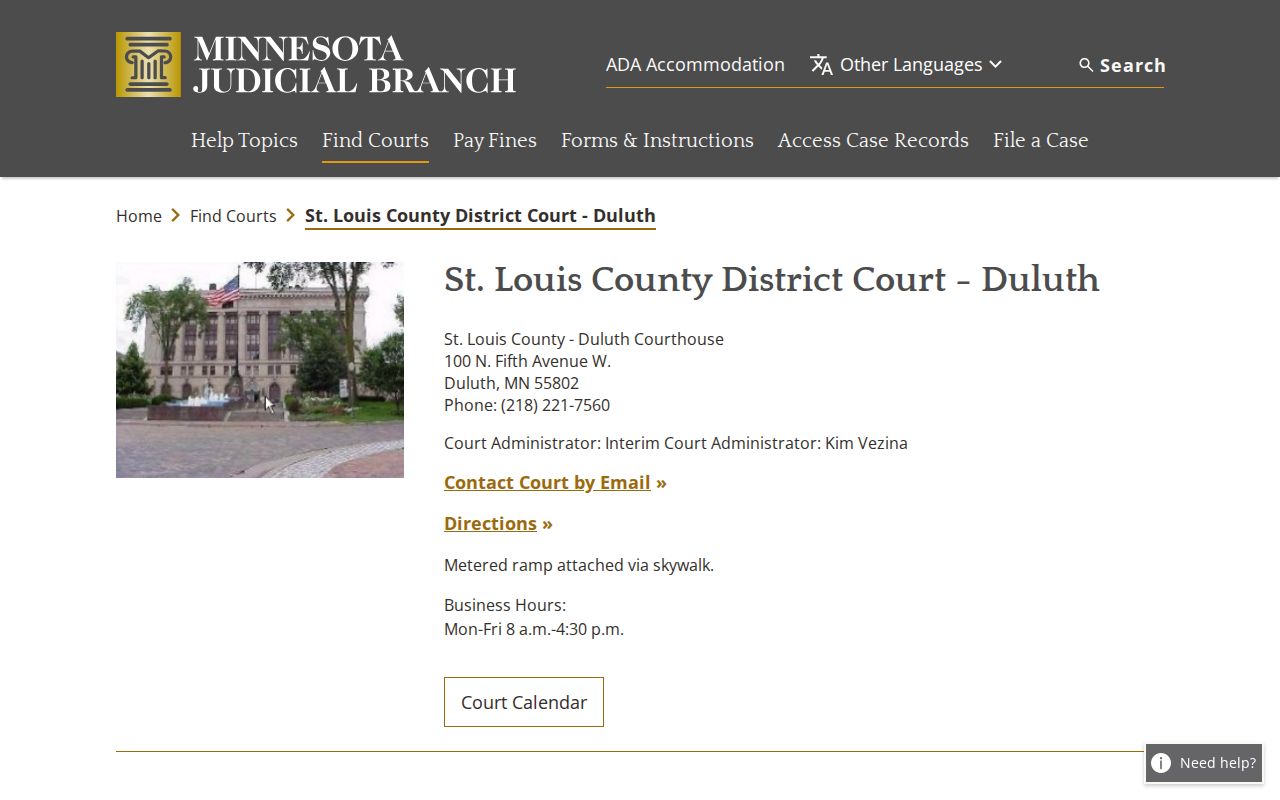
Duluth carries the heaviest caseload in St. Louis County. Its criminal division posts the clearest instructions for anyone dealing with a failure to appear or an outstanding warrant.
Which St. Louis County Courthouse Should You Call?
St. Louis County seats its judges at three full-service courthouses. Each runs its own Court Administration phone line with its own posted hours. Calling the wrong building wastes more warrant checks than anything else.
| Courthouse | Court Administration | Warrant Questions |
|---|---|---|
| Duluth | 218-221-7560 | Choose option 4 for status, missed appearances, and scheduling. |
| Hibbing | 218-274-6007 | Choose option 4 for warrant and appearance instructions. |
| Virginia | 218-305-7021 | Choose option 4 for warrant and appearance instructions. |
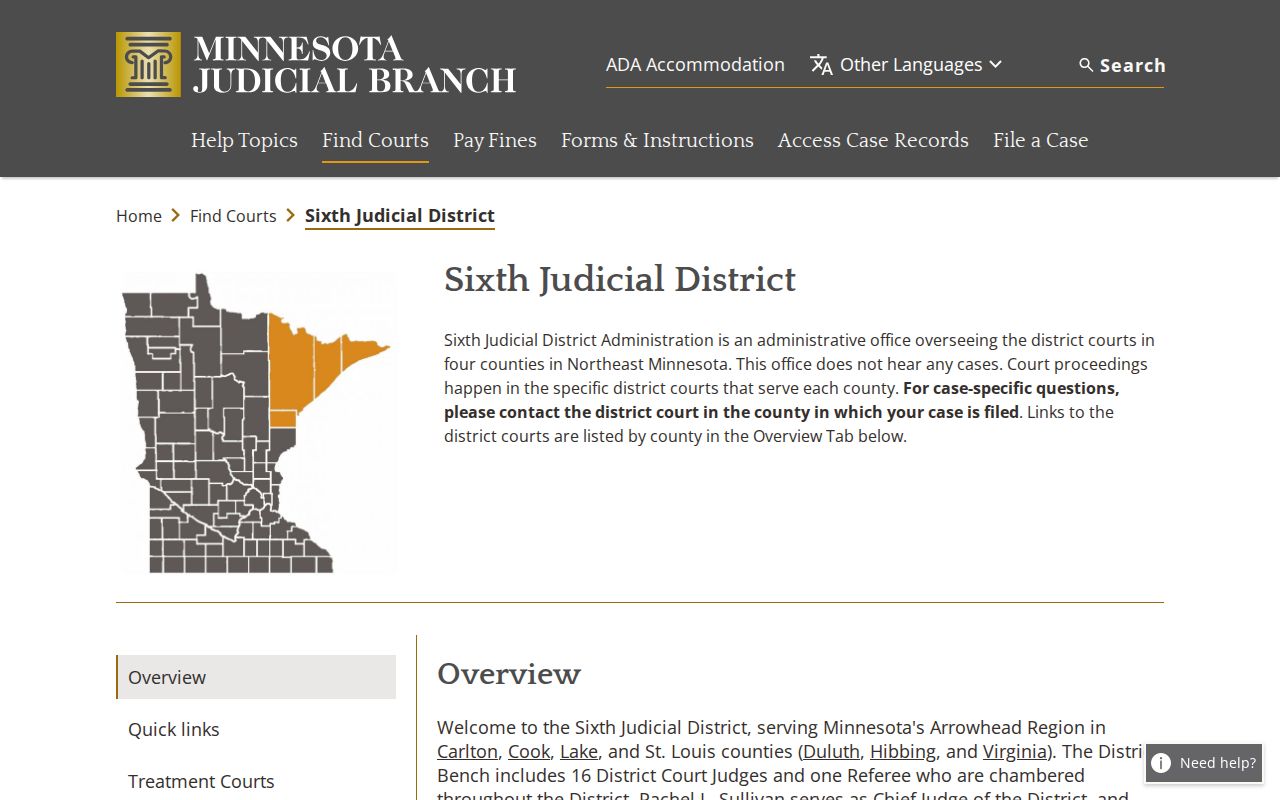
The Sixth Judicial District takes in Carlton, Cook, Lake, and St. Louis Counties. A case that affects a St. Louis County resident may sit in a courthouse outside the county.
Do Not Use the Warrant Tip Form to Check Yourself
St. Louis County's anonymous tip form serves one purpose: reporting what you know about someone with an active warrant, such as where the person might be and when. It asks for a suspect name or alias, locations, and other details. It cannot answer whether your own record is clear. Treat it as a tip line, not a self-check channel.
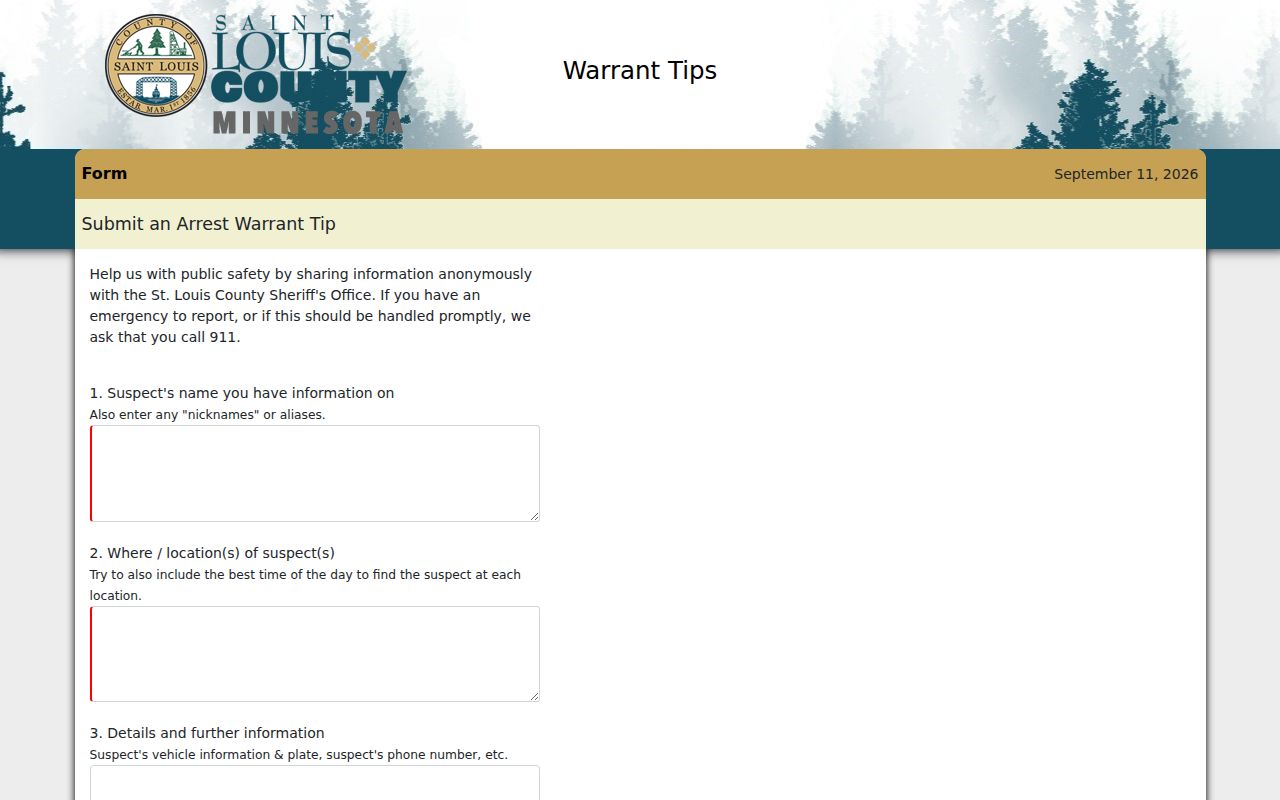
The form itself says emergencies go to 911 and that the sheriff's office makes the arrests. Nothing typed into it will recall a warrant or set a court date.
Restricted Warrants and Access Rules
Not every warrant is public, and that is by design. Minnesota classifies certain law-enforcement data, the courts limit what can be reached remotely, and juvenile matters fall under their own statute. So a blank result in St. Louis County is not clearance; it may simply mean the record is sealed or restricted.
Key Rules:
Minn. Stat. § 13.82 - the arrest warrant index can stay confidential until the person is taken into custody, served, or appears.
Rule 8 of the Rules of Public Access - remote access covers only part of what is held at the courthouse.
Minn. Stat. § 260B.171 - juvenile records are not searchable by the public in the same way.