
St. Louis County Bench Warrants Explained
A bench warrant is a judge's order, not a new charge. Judges in St. Louis County sign one when a person misses a required hearing or ignores something the court ordered, like a release condition or a payment. No new document gets filed over the missed date. The warrant just gives officers authority to bring the person back before the judge.
St. Louis County's Bench Warrant Fail-to-Appear Label
St. Louis County lists that name the most common version use plain wording: bench warrant, fail to appear at a hearing. All that phrase tells you is a court date was missed. What the underlying case involved is another matter, which is why the court file counts more than the list line.
- Bench warrant
- Court order issued after a missed hearing or another failure to comply.
- FTA
- Failure to appear at a setting the court required.
- Sign-and-release warrant
- A limited warrant that does not authorize arrest or require bail.
- Recall or quash
- Court action that withdraws the order. Only the court can do it.
- Bond forfeiture
- Loss of posted money when a person does not return as promised.
How St. Louis County Bench Warrants Are Issued
Rule 3 of the Minnesota Rules of Criminal Procedure decides whether a case starts with a summons or a warrant. A summons is the normal route. A fine-only misdemeanor generally gets a summons. A St. Louis County judge signs a warrant instead when the rule's conditions are met, which can include a substantial likelihood the person will not respond, difficulty finding them, or a need to prevent imminent harm. Once the order is signed, the Sixth Judicial District transmits the warrant information to the sheriff's office, and the entry then joins statewide and national law-enforcement databases.
Why a St. Louis County Bench Warrant Starts With a Missed Date
Many people figure a missed date fixes itself if nothing shows up in the mailbox. It does not. The hearing moves forward without them, the judge decides, and the case can sit open for years on one absence. A blank result on a St. Louis County list answers nothing either, since the file rebuilds once a night and some records never appear publicly. Note: The surest way to learn your standing is to call the courthouse that heard the case and ask.
Bench Warrants and Arrest Warrants Compared
People use the two terms interchangeably, and both let an officer take a person into custody in St. Louis County. The difference is what started the case.
| Point of Comparison | Bench Warrant | Arrest Warrant |
|---|---|---|
| What triggers it | Missed hearing or noncompliance | Complaint and sworn facts showing probable cause |
| Where the case starts | A case already before the court | A new criminal charge |
| Who signs it | District court judge | District court judge |
| Usual first step | Ask the court for a new date | Talk with a lawyer about appearing or surrendering |
St. Louis County Bench Warrants and Sign-and-Release
Minnesota has a narrower order that gets confused with a standard St. Louis County bench warrant. State law allows a sign-and-release warrant after certain summons failures to appear, and it carries real limits.
Key Rules:
Minn. Stat. § 629.415 - a sign-and-release warrant does not authorize an arrest and does not require bail.
The record must identify the order as sign-and-release, so do not assume every bench warrant works this way.
Resolving a St. Louis County Bench Warrant
The judge controls the whole process. A new date, a bond amount, conditions, or a recall are all open to a St. Louis County court. None of them happens until the person appears or arranges to appear.
Take it seriously: A bench warrant stays in law-enforcement databases until the court withdraws it, and a traffic stop can turn into a custodial arrest.
- Confirm the order with Court Administration, then ask which court issued it.
- Ask what the court wants next: an appearance, a payment, a reset, or a hearing on the record.
- Arrange a lawyer, and ask about a public defender if you cannot afford one.
- Follow the same path described in the county warrant overview for any order in your name.
St. Louis County Ordinance Cases and Bench Warrants
Cities write ordinance citations, but Minnesota sends those cases through district court rather than a separate city court system. St. Louis County has no independent municipal court office running its own docket. So an ordinance matter that goes sideways can end with a district court bench warrant. The state guidance on local ordinances lays out the routing and keeps city cases inside the same court system that answers warrant questions.
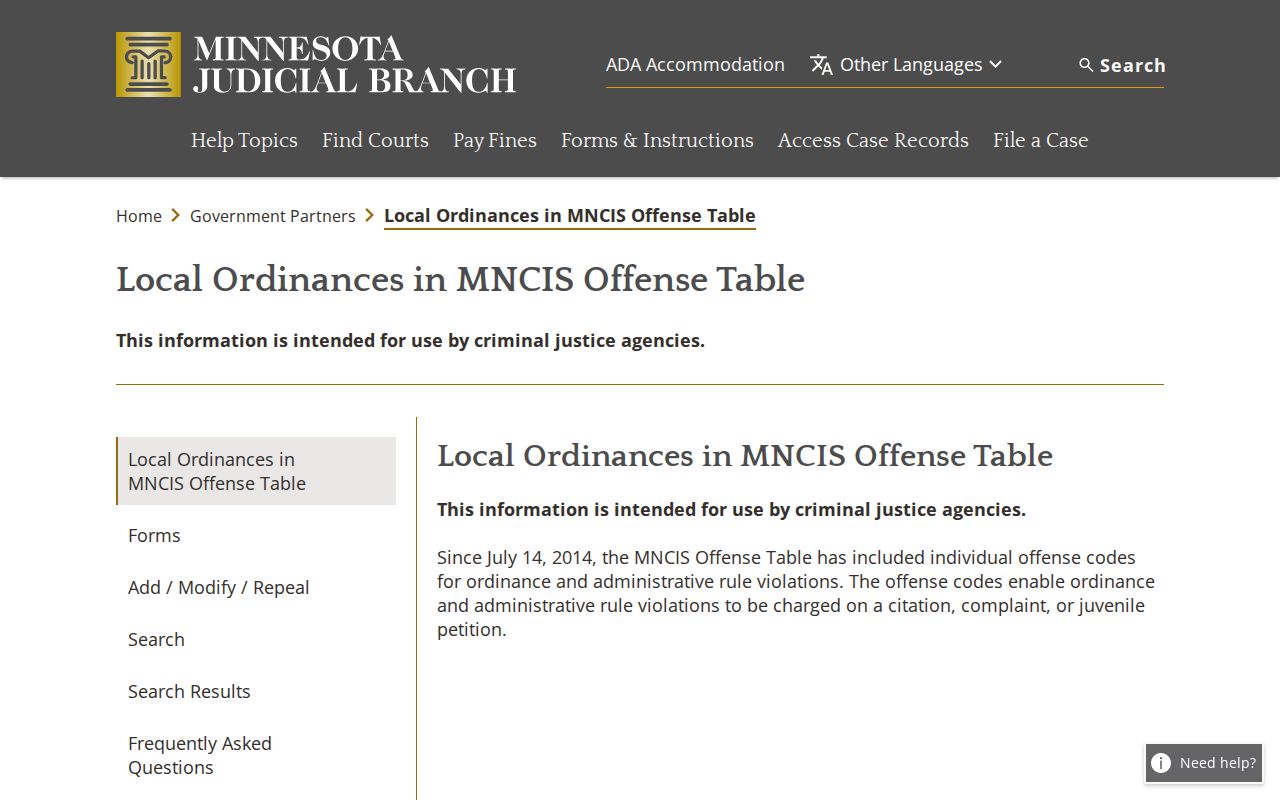
That routing is why a bench warrant from a small city case gets confirmed at the St. Louis County district court counter, not at city hall.
Finding the Court That Issued the Warrant
St. Louis County staffs judges in three full-service courthouses. The one holding the case is the one that answers the question. Each desk runs its own phone line and posted hours.
Duluth District Court
100 N 5th Ave W, Duluth, MN 55802
218-221-7560, option 4
Hibbing District Court
1810 E 12th Ave, Hibbing, MN 55746
218-274-6007, option 4
Virginia District Court
300 5th Ave S, Virginia, MN 55792
218-305-7021, option 4
Asking the Court to Recall a St. Louis County Warrant
St. Louis County publishes no motion-to-recall form you can download and file, which surprises people. Recall happens through the court, usually after an appearance or an agreement about conditions, and a lawyer often handles it rather than a form. On your own, call the location that issued the order, explain the situation, and ask what the court requires. Duluth also runs a Tuesday morning walk-in at Room 133 of the courthouse. A person with an outstanding warrant can check in at 8:30 AM and get added to that day's calendar. Note: A record request does not recall a warrant and does not pause enforcement while it is processed.